

You make a plan, feel excited for a few days, and then life happens. One missed morning becomes a week, and suddenly you are wondering why you can never stick with anything.
Struggling with consistency can be a sign that your plan needs adjusting, rather than a reason to judge your character. Your habit may be too big, too vague, or too dependent on having an unusually easy day.
Instead of asking how to become a completely different person, ask what would make this habit easier to repeat in the life you have now. That gives you something concrete to work with.
Check whether your plan fits your actual day
It is easy to build a routine around your most motivated self. That version of you has extra time, plenty of energy, and no unexpected errands.
Your ordinary Tuesday might look very different. A useful plan needs room for work, meals, family responsibilities, and the evenings when you feel tired.
Think about the last time your habit fell apart. Was the timing awkward, were the supplies hard to find, or did the habit take longer than you expected?
Make the next attempt fit the obstacle you actually noticed. If a long evening walk keeps getting skipped, try a short walk at lunch or after dinner.
Choose a minimum you can realistically repeat
There is a difference between your ideal routine and the smallest version that still counts. Having both gives you more flexibility.
Your ideal might be reading a chapter. Your minimum could be reading one page before putting your phone on its charger.
For tidying, it might be clearing one surface. For journaling, it might be writing one honest sentence.
A small version gives you somewhere to begin on a difficult day. You can do more when you have the capacity, without making the bigger version the entry requirement every time.
Give the habit a clear place in your day
“I will take better care of myself” leaves you with several decisions to make later. A specific plan tells you what to do and when to start.
Try this: “After I make my morning coffee, I will write down the one task I most want to finish today.” Or: “After I brush my teeth, I will read one page.”
Choose a moment that already happens fairly reliably. If your schedule changes often, use an event such as arriving home rather than an exact time.
Make getting started less complicated
Look at everything you need to do before the habit itself. Searching for your shoes, finding a notebook, or choosing a workout can turn a small intention into a project.
Set out what you need when you have a few spare minutes. Pick the book, put the notebook beside your mug, or decide which short walk you will take.
You can also remove a step. A note on your phone may be a more practical place to plan tomorrow than a beautifully arranged journal you rarely open.
Decide how you will return after a missed day
Missing a day can happen even with a thoughtful plan. The trouble often grows when one missed attempt becomes proof that the whole effort has failed.
You do not need to punish yourself or catch up before you begin again. At the next reasonable opportunity, do the smallest version of the habit.
If the same problem keeps happening, use that information. Change the timing, reduce the size, or choose a different habit that better supports your current priorities.
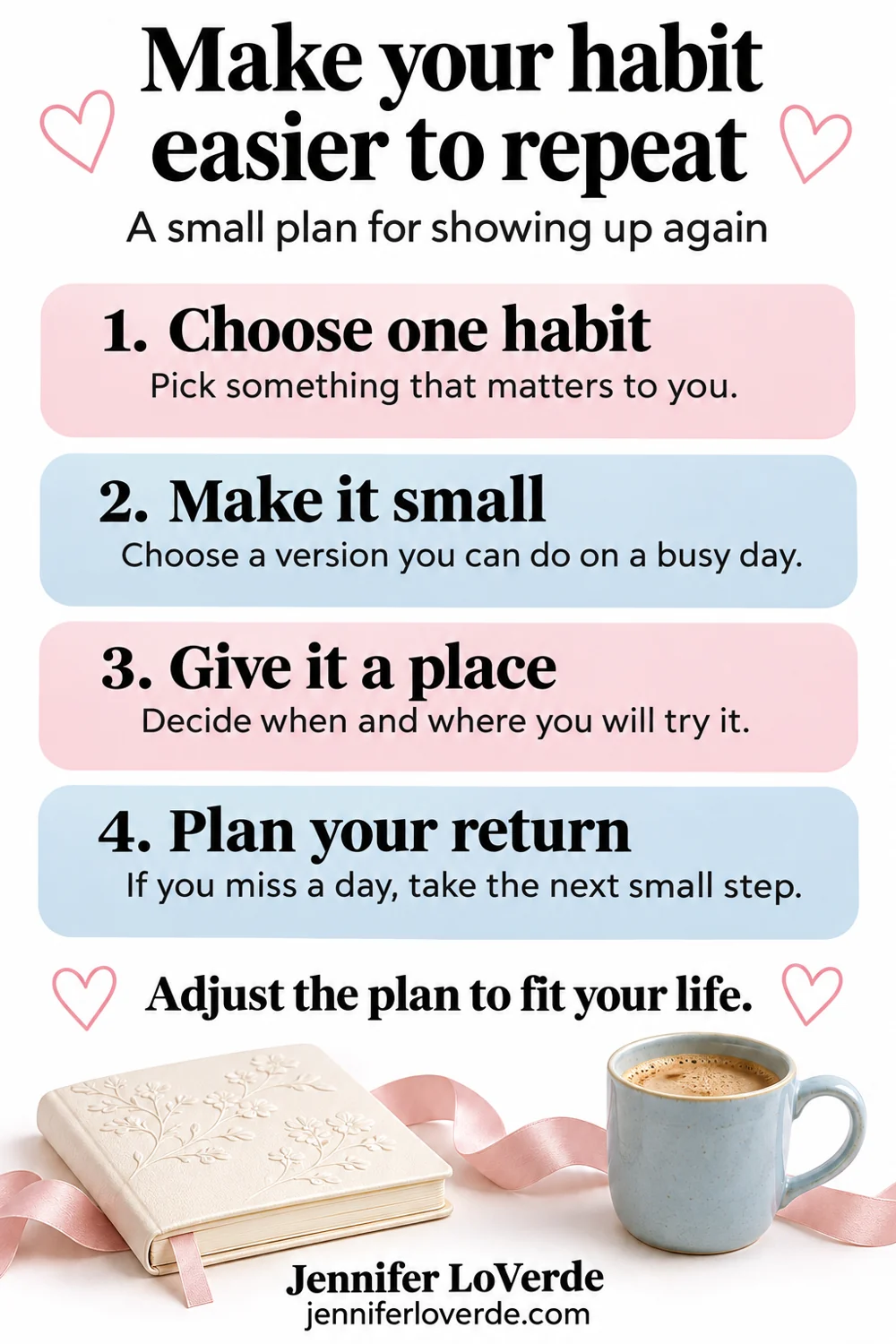
Try this for the next week
Choose one habit you want for your own reasons. Write down its smallest version, the moment you will do it, and the obstacle you will prepare for.
At the end of the week, ask what felt manageable and what needs changing. A simple check mark can help you notice patterns, but you do not have to turn the week into a score of your worth.
You are allowed to build consistency through adjustment. Start with a promise that fits your day, and give yourself a clear way to return when life interrupts it.
If a simple way to track your attempts would help, my Habits & Consistency Habit Tracker Bundle includes daily, weekly, and monthly trackers so you can choose a view that fits your habit.

Leave a Reply